
Your vendors' tax forms, collected and kept current.
Send a link. We ask the right questions, they sign, you get a correct W-9 or W-8 back. We track the expiry so you don't have to.
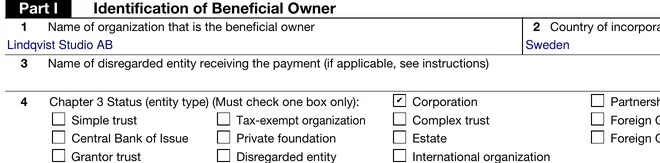

- W-9 · W-8BEN · W-8BEN-E · W-8ECI
- Treaty checks for 56 countries
- Expiry tracked automatically
- Filled on the official IRS PDF
- One account, every client or entity
How it works
1.Add a vendor
Name and email. The request goes out under your company's name, or under a client's if you collect for more than one business.
2.They complete the guided form
A few plain questions pick the right form; every answer is checked as they go, then they sign. Out comes the official IRS PDF, filled.
3.You review and approve
Routine forms are ready to activate in one click; anything unusual is flagged with the reason.
New
One account for every business you collect for.
Bookkeeping firms, agency groups and companies with more than one entity: add each one as a payer, invite the people who do the work, and give each of them only what their role needs.
A payer for every business you collect for.
Each client, subsidiary or studio is its own payer. Vendors get the request in that business's name, with its contact details, and the signed forms stay filed under it.
Roles instead of a shared password.
Members add vendors and send requests. Admins approve forms and can reveal a tax ID. The owner handles billing. Everyone signs in with their own login and two-factor.
Every client in one queue.
Switch into one payer, or see every vendor and every form waiting for review across all of them. When a client leaves, archive the payer; its forms stay on file.
Why this matters
When a vendor's form is missing or invalid, the IRS doesn't go to the vendor. It comes to you, the payer: 24% backup withholding on US payees, 30% on payments to foreign ones, plus a penalty per form. All of it on money you've already paid out.
“Invalid” is easy to reach. A W-9 from a company that should have sent a W-8, or a W-8 with one box missed, counts as if you'd collected nothing.
And a valid W-8 doesn't stay valid. It lapses at the end of the third year, or the day the vendor moves. Nobody tells you. The form quietly stops counting while the payments keep going out, and every one of them is now exposed.
Built to be trusted with tax forms
E-signed, with a consent record.
Vendors agree to sign electronically before they start. Consent, signing and submission are each logged with time, IP and device.
Identity checked before signing.
A one-time code goes to the vendor's email, and the form can't be submitted until it's confirmed.
Tax IDs masked by default.
After submission, TINs show as the last four digits. Members on your team never see more; for admins, revealing one is a deliberate action, and it's logged.
Two-factor on every account.
Everyone on your team sets up an authenticator before they can see a form. There's no way to skip it.
Signed forms are kept for at least four years, in line with IRS recordkeeping rules. The full picture — hosting, encryption, retention, what we don't claim — is on the security page.
Start free. Pay when it's working.
Send as many requests as you like. Your first 3 signed forms are free; after that a plan is $29 to $149 a month, and you only ever pay for forms your vendors actually complete.